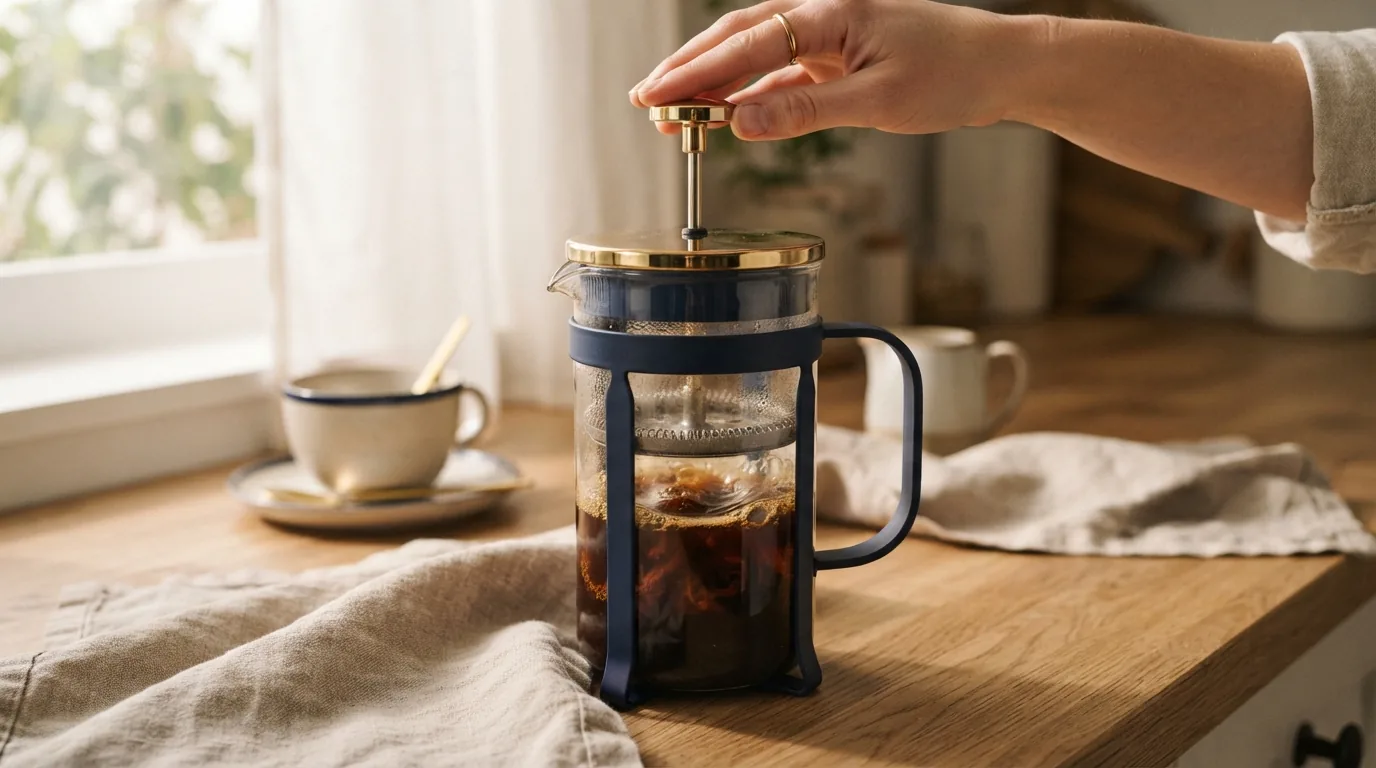
The French press hasn't changed its basic mechanism since the design was patented in the 1920s: coarse grounds steep directly in hot water, then a mesh plunger separates the grounds from the finished coffee. That full-immersion method produces a heavier, more full-bodied cup than any paper-filtered method, since the mesh plunger lets oils and fine sediment through that a paper filter would trap.
The category hasn't stood still, though. Modern presses address the original design's two real weaknesses, heat loss and gritty sediment, without changing the basic brewing method itself.
Best French Press 2026: The Rankings
Fellow Clara French Press
Double-wall vacuum insulation for stable brew temperature, enhanced filtration mesh, all-direction pour lid, 24oz, $99.95
Bodum Chambord French Press
The original 1958 design in borosilicate glass and chrome-plated steel, simple and easy to replace parts for, $39.95
Why Sediment Is the French Press's Real Weakness
A standard single-mesh plunger, the kind Bodum and most classic presses use, lets a meaningful amount of fine coffee grit pass through into the finished cup, which is why French press coffee can taste gritty by the last sip. The Espro P7 addresses this directly with a patent-pending two-stage micro-filter, two nested filters that snap together with a double lip seal, trapping sediment far more effectively than a standard single mesh without changing the full-immersion brewing method itself.
Espro P7 French Press
Patent-pending dual micro-filter system with a double lip seal, double-wall vacuum insulated, 32oz, $119.95
Why Heat Retention Matters More Than It Sounds
A classic glass French press loses heat quickly once the water goes in, which means coffee steeping near the end of the four-minute brew is already extracting at a lower temperature than coffee at the start, an inconsistency that shows up as a flatter, less balanced cup. Double-wall vacuum insulated presses, like the Fellow Clara and Espro P7, hold a far more stable brew temperature throughout, and keep the finished coffee meaningfully hotter for serving afterward too.
“A French press hasn't needed a new brewing mechanism in a century. What it needed was a better filter and a body that doesn't lose heat the moment water hits it.”
Grind Size Matters More Here Than in Most Methods
A French press specifically needs a coarse, uniform grind, roughly the texture of coarse sea salt. Too fine, and grounds slip through the mesh regardless of which press you're using, plus the brew over-extracts and turns bitter; too coarse, and the coffee comes out weak and underextracted. Our French press vs pour-over vs AeroPress guide covers how the grind and immersion time work together for this method specifically.
Sizing to How You Actually Drink
French presses are sized in cups, but those are small coffee-cup measurements, not full mugs; a "34oz" or "8-cup" press realistically pours about four normal mugs. Buying too small means brewing twice for a household of two or three; buying too large for someone who drinks one cup a day means brewing more than needed and wasting beans, since a French press doesn't hold heat well enough to save the extra for later without it degassing and going flat.
Pairing With the Rest of Your Setup
A French press is only as good as the grind going into it; a blade grinder's inconsistent particle sizes will always let some grit through recent filter improvements or not. Our best manual hand grinders guide covers grinders built for the specific coarse, consistent grind a French press needs.