These three methods get lumped together as "manual brewing," but they produce genuinely different cups through genuinely different mechanics. Full immersion versus drip filtration versus pressure-assisted immersion. Picking between them isn't about which is objectively best; it's about which mechanism produces the cup, the cleanup, and the morning routine you actually want.
Cost of entry is similar across all three. None of these require the investment of an espresso setup, which is part of why they're often the first serious brewing upgrade someone makes after years of a basic drip machine. The real cost difference over time comes down to consumables: paper filters for pour-over and AeroPress add a small recurring cost that French press, with its reusable metal mesh, avoids entirely.
French Press: Full Immersion
A French press steeps coarsely ground coffee directly in hot water for several minutes before a metal mesh plunger separates the grounds from the liquid. Because the mesh filter lets fine particles and oils through that a paper filter would catch, French press coffee has a heavier body and more pronounced mouthfeel than filtered methods. Some drinkers love that richness, others find it muddy by comparison.
It's also the simplest method here by a wide margin: no technique to learn, no pour pattern to practice, no filter to buy separately. The tradeoff is a small amount of sediment in the bottom of the cup and a slightly less clean flavor profile than a paper-filtered method.
Bodum Chambord 34oz
The reference French press, borosilicate glass, stainless frame, $54.95
Pour-Over: Drip Filtration
Pour-over methods like the Hario V60 rely on a paper filter and a controlled, manual pour to extract coffee through gravity alone. The paper filter catches fine particles and most of the coffee's natural oils, producing the cleanest, brightest cup of the three methods. The difference between origins and roast profiles shows up most clearly here, which is why pour-over is the default method at most specialty coffee bars.
The tradeoff is technique. Pour rate, pour pattern and bloom timing all measurably affect the final cup, and getting consistent results takes real practice in a way French press and AeroPress simply don't demand.
Hario V60 Ceramic Dripper
The reference pour-over dripper for spiral-groove extraction control, $26
“French press rewards simplicity, pour-over rewards technique, and AeroPress splits the difference. Know which tradeoff you actually want before you buy.”
AeroPress: Pressure-Assisted Immersion
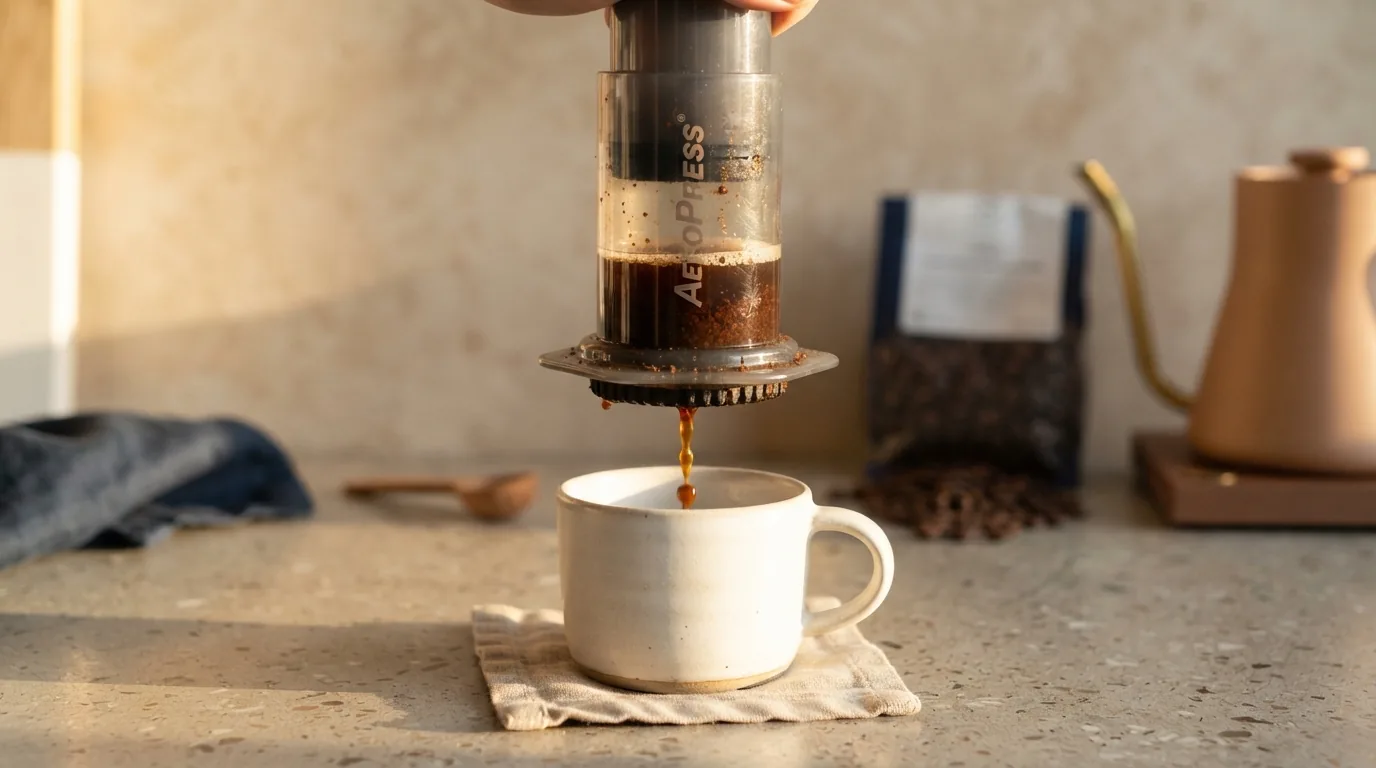
The AeroPress combines immersion brewing with manual plunging pressure through a paper filter, landing somewhere between the other two methods in body and clarity. It brews fast, often under two minutes start to finish, and its small, sealed brewing chamber makes it the most forgiving method for inconsistent grind size, which is part of why it's become the default recommendation for travel and camping.
It also produces a genuinely different cup depending on technique: standard upright brewing versus the popular "inverted" method change extraction meaningfully, which means the AeroPress has more built-in room to experiment than either other method here.
AeroPress Original
Fast, portable, pressure-assisted brewing, forgiving of grind inconsistency, $31.95
Coffee-to-Water Ratio for Each Method
Ratio matters more than most beginners realize, and it differs meaningfully between these three methods. French press typically runs around 1:12 (coffee to water by weight) for a fuller-bodied cup; pour-over methods like the V60 usually run leaner, around 1:16 to 1:17, to keep the cup clean rather than heavy; AeroPress recipes vary widely, from concentrated 1:8 "espresso-style" shots meant to be diluted, to standard 1:15 full-cup recipes. If a cup from any of these methods tastes off, checking your ratio before blaming the beans or the grind is usually the faster fix.
Grind Size, Brew Time, and Cleanup Compared
| Method | Grind Size | Brew Time | Cleanup | Body |
|---|---|---|---|---|
| French Press | Coarse | 4–5 min | Grounds disposal, mesh rinse | Heavy, textured |
| Pour-Over (V60) | Medium-fine | 2.5–3.5 min | Discard paper filter, rinse | Light, clean |
| AeroPress | Medium-fine | 1.5–2 min | Eject puck, rinse cap | Medium, balanced |
Cleanup is a bigger practical factor than most buying guides admit. A French press means fishing out sodden grounds and rinsing a metal mesh that eventually needs replacing. Pour-over cleanup is nearly instant. Lift the paper filter, grounds and all, straight into the trash. The AeroPress lands in between: the compressed puck ejects in one piece, but the rubber seal needs occasional attention to keep sealing properly over time.
Which One Should You Buy?
Choose French press if you want the simplest possible routine and prefer a fuller-bodied cup with no technique curve. Choose pour-over if you want the cleanest, brightest expression of a specific bean and don't mind investing time in technique. Choose AeroPress if portability and speed matter as much as the cup itself, or if you want one device that can approximate either of the other two methods depending on how you use it.
Budget rarely decides this one. All three sit in a similar price range, and the real deciding factor is almost always routine. If your mornings are rushed, the AeroPress's under-two-minute brew time matters more than any flavor difference. If coffee is a slow, deliberate ritual, pour-over's demands on attention are part of the appeal rather than a downside.
None of these require an electricity outlet, and all three are inexpensive enough that most serious home setups eventually own more than one. For the grind settings that pair best with each method, see our best coffee grinders 2026 guide, or our moka pot guide if a stovetop brew is the fourth method you're actually curious about.