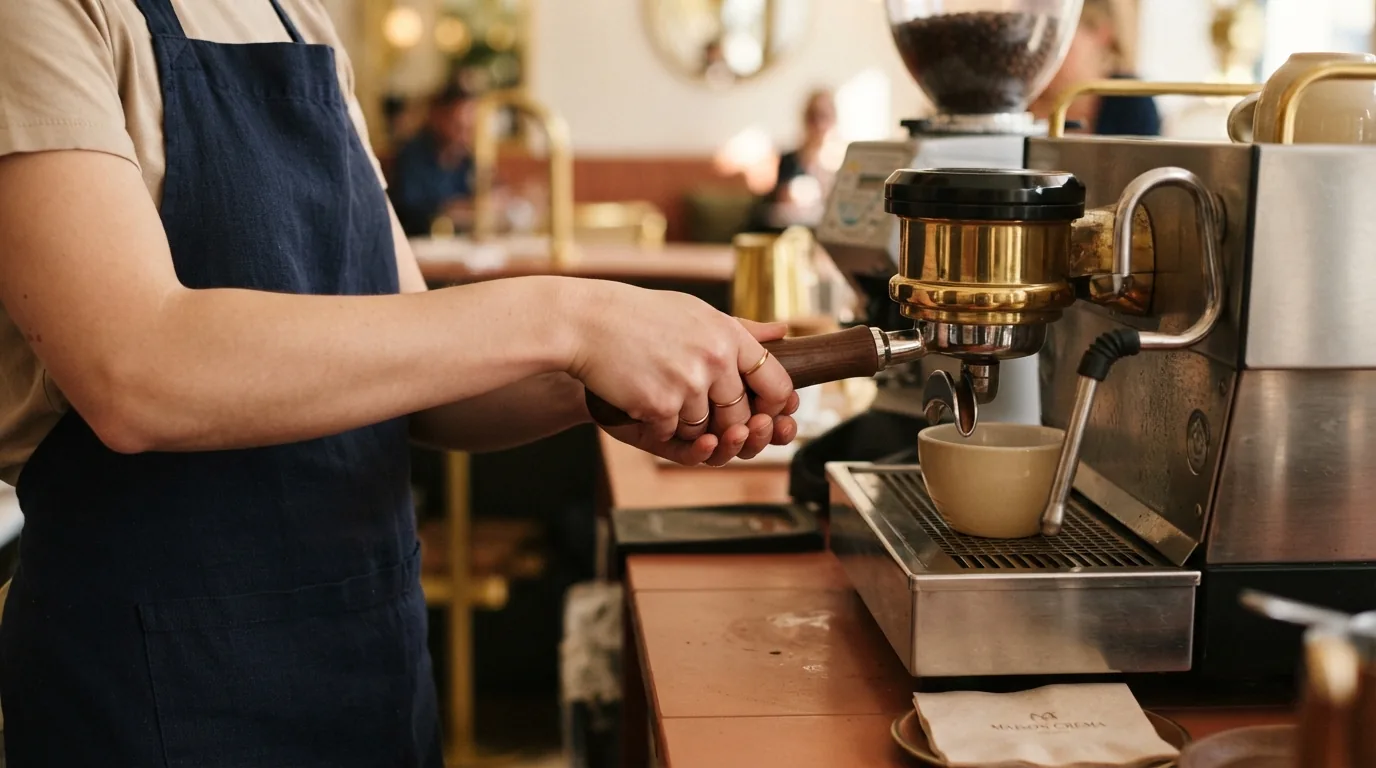
A manual lever machine replaces a motorized pump with a human hand, either pulling a spring-loaded lever or working a piston directly, to build the pressure that pushes water through the puck. It's the format espresso started on before pumps existed, and it's had a genuine resurgence among home baristas who want to feel every part of the extraction rather than watching a pump do it automatically.
How Lever Extraction Actually Differs
A pump machine builds and holds pressure at a fixed, consistent level for the duration of the shot. A lever machine puts that pressure curve directly in your hand. Push harder early for a faster initial flow, ease off mid-shot, apply a final push at the end, and the shot responds in real time. That's a genuinely different extraction, not just a different feeling, and it's the entire reason pressure-profiling on expensive automatic machines exists: it's trying to replicate, with electronics, what a lever does mechanically.
Best Manual Lever Machines 2026: The Rankings
1. Flair 58 ($699): Best Overall
The Flair 58 uses a manual piston-lever mechanism paired with a pressure gauge that gives real-time feedback as you pull, turning what could be pure guesswork into something you can actually read and adjust. It requires an external kettle for hot water, since it has no boiler of its own, but that's a deliberate tradeoff. No boiler means no warm-up wait and a genuinely portable machine that packs down for travel.
Flair 58 Manual Lever Espresso Machine
Piston-lever extraction with real-time pressure gauge, no boiler, fully manual, $699
2. ROK EspressoGC Classic Plus ($259): Best Fully Manual, No Electricity
The ROK strips the concept down further still: no boiler, no pump, no electricity anywhere in the device. You supply hot water from a kettle, load the portafilter, and pull two spring-assisted arms down to build pressure by hand. It's the most portable machine in this guide by a wide margin, genuinely usable anywhere you can boil water, and its re-engineered glass-composite pressure chamber holds up to repeated daily use better than the original design it replaced.
ROK EspressoGC Classic Plus Manual Espresso Maker
Fully manual, no electricity required, spring-assisted lever arms, glass-composite chamber, $259
“A lever machine doesn't automate a single part of the shot. That's not a limitation for the people who buy one. It's the entire point.”
Why Neither Needs a Boiler
Both machines skip the single most expensive and failure-prone component of a typical espresso machine entirely. You supply hot water yourself, from an electric kettle, a stovetop kettle, or even a thermos on the go. That single design choice is what makes both machines meaningfully cheaper than an equivalent pump machine and considerably more travel-friendly, at the cost of one extra step every single time you want a shot.
The Learning Curve Is Real
Neither machine is plug-and-play. Building consistent pressure by hand, and reading a gauge or your own sense of resistance to know when to ease off, takes real practice, more than a portafilter machine with a fixed pump profile requires. That learning curve is a genuine part of the appeal for the people who buy into this category, and a genuine reason to skip it for anyone who just wants a reliable shot with minimal daily thought. If that's you, our semi-automatic machines guide is a more forgiving place to look.
Pairing a Lever Machine With the Right Grind
Because you're building pressure manually rather than relying on a fixed pump curve, grind consistency matters even more here than on an automatic machine, since an inconsistent grind gives your hand less predictable resistance to read. Our best conical burr espresso grinders 2026 guide covers grinders built specifically for the consistency a lever machine rewards, and if portability is the whole point of your setup, our best manual hand grinders 2026 guide covers a grinder that travels just as well as the ROK does.
What Hot Water Source Actually Works Best
Since neither machine heats its own water, the quality of your kettle matters more here than it would on a machine with a built-in boiler. A variable-temperature electric kettle lets you hit a consistent target temperature shot after shot, rather than guessing based on how long water sat off the stove. Our best electric gooseneck kettles 2026 guide covers options that pair naturally with either machine here, and the gooseneck spout's controlled pour also makes filling the Flair 58's small water chamber considerably less messy than pouring from a standard kettle.
Portability Beyond the Kitchen
Both machines pack down small enough for genuine travel use, camping, an Airbnb kitchen, a hotel room with an in-room kettle, in a way no plumbed-in or boiler-based machine can match. The ROK in particular weighs little enough to justify bringing on a trip specifically for coffee, not just as a novelty, and neither machine has a single electronic component that could fail from a power surge or an incompatible outlet abroad, which matters more than it sounds like when traveling internationally.