Most espresso machine comparisons stop at price and features. They'll tell you a semi-automatic costs less than a super-automatic, or that a super-automatic has a built-in grinder. What they skip is the tradeoff that actually determines whether you'll be happy with the machine in six months: how much control do you want over the shot, and how much of that control are you actually willing to exercise every morning?
That question matters more than horsepower, more than boiler type, more than brand reputation. A semi-automatic and a super-automatic can use nearly identical pumps and nearly identical water systems and still produce a completely different daily experience, because the real difference between them isn't mechanical. It's how much of the extraction process you're responsible for.
How Semi-Automatic Machines Work
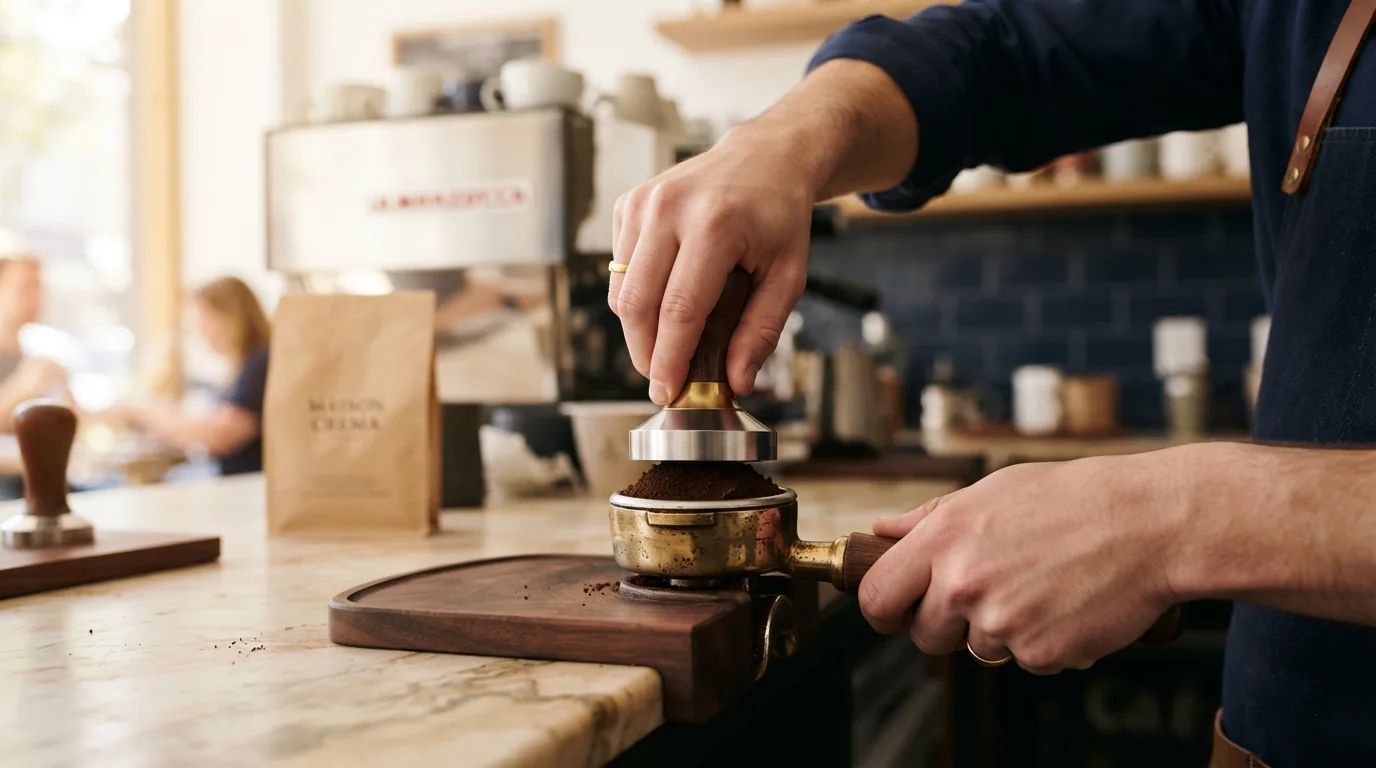
A semi-automatic espresso machine hands you the portafilter, a grinder (built-in or separate), a tamper, and a pump that starts and stops on your command. You grind the dose, distribute it, tamp it, lock the portafilter into the group head, and start the shot manually. Watching the extraction, timing it, and stopping it when the shot looks and tastes right.
This is the format nearly every serious home barista eventually gravitates toward, and nearly every professional bar runs on. The reason is straightforward: grind size, dose, distribution and tamp pressure are the four variables that most directly shape extraction, and a semi-automatic gives you direct control over every one of them. If your shot runs sour, you can tighten the grind on the next pull. If it's bitter and harsh, you can dial it back. You're not waiting on a firmware update or a preset. You're adjusting a burr and trying again.
The tradeoff is obvious: it takes practice. Your first few weeks with a semi-automatic machine will produce inconsistent shots while you learn what "correctly dosed" and "evenly tamped" actually feel like. But that learning curve is also the entire appeal. A semi-automatic machine rewards attention with a genuinely better cup, and it keeps rewarding it as your technique improves. There's no ceiling built into the hardware.
Breville Barista Express Impress
Built-in conical burr grinder with assisted tamping, $699.95
How Super-Automatic Machines Work
A super-automatic machine automates the entire chain: it grinds on demand, doses by weight or volume, tamps internally, and pulls the shot on a pre-programmed pressure and volume profile, often finishing with automated milk texturing. You load beans and water, press one button, and a cup appears. There's no portafilter to lock, no manual timing, and in most cases, nothing to learn beyond which button corresponds to which drink.
What's gained is obvious: speed, consistency between users, and zero technique requirement. A super-automatic is the right call for a household where three different people want three different drinks before 8 a.m. and none of them have the time or interest to learn portafilter technique. It's also considerably more forgiving of inconsistent bean freshness, since the internal grinder and dosing system are tuned to compensate within a narrow range.
What's lost is equally obvious: you can't taste a shot running slightly fast and correct the grind mid-morning. You're bound to whatever range of adjustment the manufacturer built into the software, and on cheaper units, that range is narrow. You also lose the tactile ritual entirely. For some buyers that's irrelevant, for others it's the entire point of owning a machine instead of walking to a café.
“The best machine isn't the one with the most features. It's the one whose control model matches how much of the process you actually want to own.”
The Quality Tradeoff
In skilled hands, a semi-automatic machine produces a more consistently excellent shot than any super-automatic on the market, full stop. The reason is that a human dialing in fresh beans can respond to variables, humidity, bean age, roast date, that no automated system currently senses in real time. A barista who's pulled a thousand shots on the same machine can taste a problem and fix it before the next cup.
But "in skilled hands" is doing a lot of work in that sentence. In unskilled hands, a semi-automatic machine is wildly inconsistent. And a super-automatic, which removes the variables a beginner is most likely to get wrong, will often out-perform a novice on a manual machine for the first several months. The gap narrows the more convenience-focused super-automatics have improved their internal pressure profiling and grind calibration, and for most home users, that gap is now genuinely small.
Which to Choose
Match the machine to how you actually want to spend your mornings, not to how you imagine you might want to spend them.
By skill level
If you want to learn real espresso technique and don't mind a few inconsistent shots while you get there, choose semi-automatic. If you want convenience above all else and have no interest in the craft side of it, choose super-automatic.
By space and budget
Semi-automatics paired with a separate grinder take up more counter space but usually cost less at the entry level. Super-automatics consolidate the grinder and machine into one footprint, which matters in a small kitchen, but that convenience carries a real price premium. Our budget-tier breakdown covers what your money actually buys at each price point.
By lifestyle
Households making multiple different drinks quickly, especially with milk, tend to be happier with a super-automatic. Anyone who treats their morning coffee as a ritual worth five extra minutes will get more satisfaction from a semi-automatic.
Our Top Picks
Breville Barista Express Impress
Integrated grinder plus assisted tamping removes the hardest part of the learning curve, $699.95
Jura ENA 8
One-touch espresso and milk drinks with genuinely capable internal grinding and dosing, $1,699
Gaggia Classic Pro
A commercial-style steam wand and fully manual control at an entry-level price, $449
Conclusion
There's no universally "better" format here, only a better fit for how you actually want to make coffee. If you're still deciding, spend time with our full breakdown of the machine collection, where we cover every format in more depth, or see our best espresso machines 2026 ranking if the semi-automatic route with a built-in grinder sounds like the right entry point for your counter.