Puck preparation is the part of espresso that happens entirely before you press the button, and it's where most shots are won or lost. Grind size gets the attention because it's the variable with a dial attached, but a perfectly dialed grind poured into an uneven bed of coffee will still channel, and a channeled shot cannot be fixed by anything downstream.
The goal is narrow and specific: produce a coffee bed of uniform density with no clumps, no gaps against the basket wall, and a level surface. Water always takes the path of least resistance, and puck prep is the practice of making sure no such path exists.
Why Grounds Don't Land Evenly on Their Own
Coffee leaving a grinder clumps. Fine particles carry a static charge and stick to each other and to the chute, and they fall into the basket in an uneven mound that's denser in the middle and looser at the edges. Tamping that mound as-is doesn't correct it, it compresses the unevenness in place, preserving the low-density regions that water will later exploit.
This is the problem every puck prep step exists to solve, and it's why distribution has to happen before tamping rather than instead of it.
Step One: Dose by Weight
Weigh the dose into the basket rather than relying on a timed grind. Timed dosing drifts as burrs wear and as bean density changes between bags, which means the thing you're trying to hold constant quietly moves. A basket has a design capacity, and consistently overfilling it leaves too little headroom between puck and shower screen, while underfilling leaves the puck loose enough to fracture under pressure. Our coffee scales guide covers the 0.1g precision espresso actually needs.
Step Two: WDT, the Step That Fixes Clumping
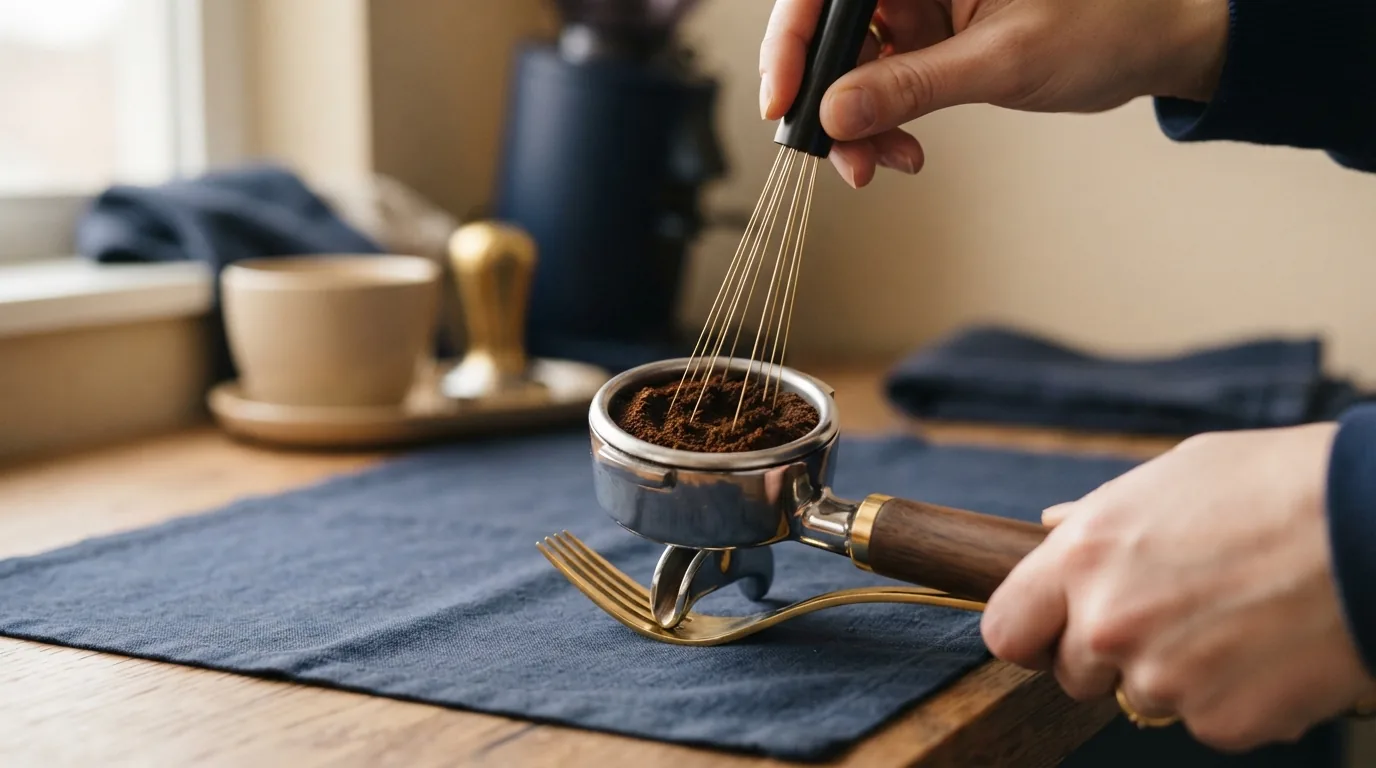
The Weiss Distribution Technique is the practice of stirring the dry grounds in the basket with thin needles to break up clumps and redistribute the coffee evenly before tamping. It's named after John Weiss, a retired professor with a PhD in biochemistry from Vanderbilt University, who documented it on the Home-Barista forum in December 2005 after concluding that poor grounds distribution was what was causing his channeling.
Weiss originally used a single dissection needle. Modern tools use multiple slim needles, typically in the range of about 0.1 to 0.5 millimeters in diameter, mounted in a handle so the whole bed can be raked in a few seconds. The technique costs almost nothing and addresses the single most common cause of channeling in home setups.
Normcore WDT Distribution Tool V3 with Stand
Nine 304 stainless steel needles in 0.25mm and 0.3mm options, anodized aluminum CNC body, padded stand to hold it between shots, around $34.99
Step Three: Level the Bed
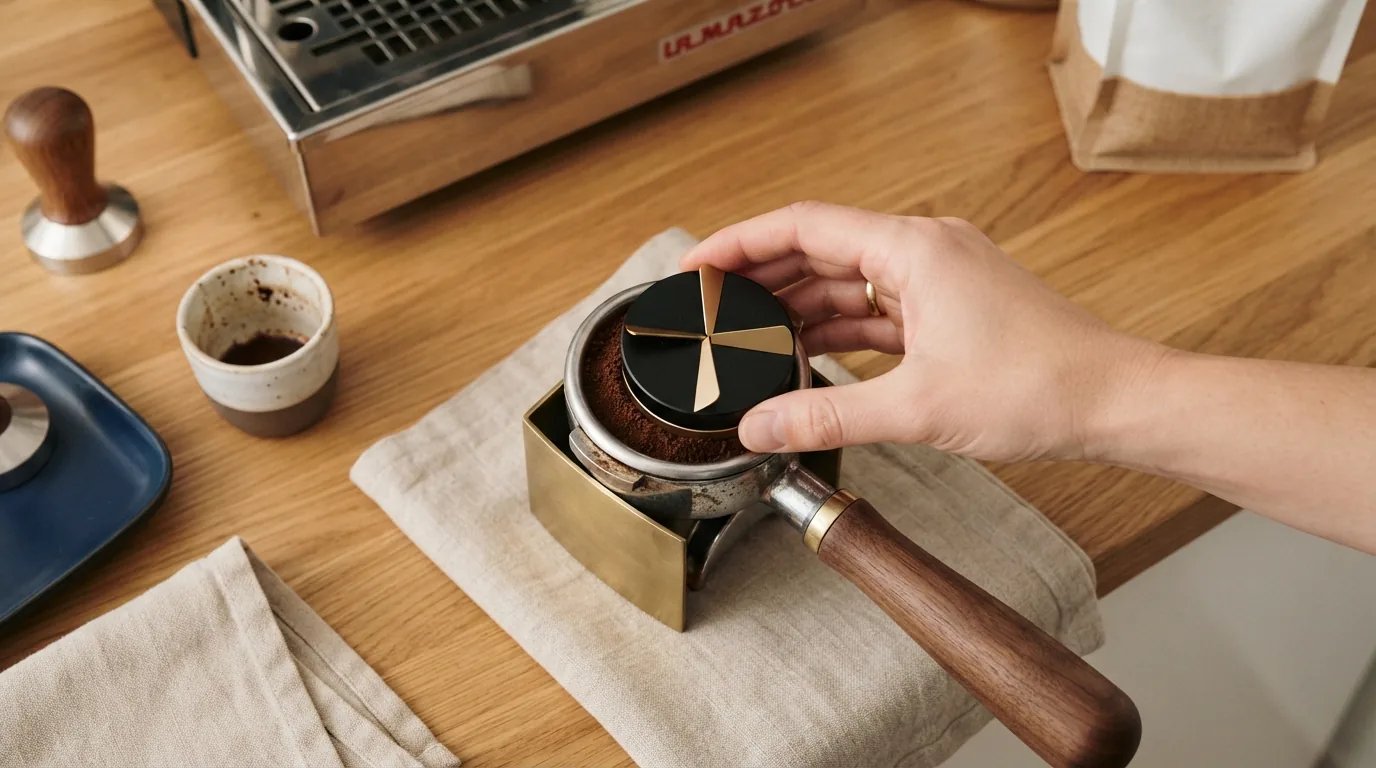
After WDT the grounds are declumped but the surface may still be uneven, and any slope becomes a density gradient once you tamp. A gentle tap of the portafilter on the counter settles the bed, or a distribution tool spun lightly across the surface levels it without compressing. The distinction matters: a distribution tool levels, a tamper compresses, and using one for the other's job produces a worse puck than doing neither.
Step Four: Tamp Level, Not Hard
Tamping pressure matters far less than people assume. Past roughly 15 pounds of even pressure the puck is already dense enough to resist water, and pushing harder changes very little. What does matter is that the tamp is level, because a tilted tamp creates a thinner, lower-resistance region on one side that water will find immediately.
Consistency is the other half. Tamping firmly one day and lightly the next shifts puck density enough to change extraction time noticeably, which is exactly the variable a calibrated spring-loaded tamper removes by compressing to a fixed pressure and then stopping. Our espresso tampers guide covers calibrated options.
“Tamping harder is the most common instinct and the least useful one. The puck doesn't need more force. It needs the force it already gets to arrive evenly.”
How to Tell If It Worked
A bottomless portafilter turns puck prep from guesswork into something you can watch. A well-prepared puck produces a single centered stream that converges smoothly a couple of centimeters below the basket. A poorly prepared one sprays thin jets sideways, or runs visibly faster on one side. You'll see the result of a distribution change immediately rather than inferring it from taste three shots later. Our bottomless portafilters guide covers sizing one to your machine.
What This Can't Fix
Puck prep solves distribution problems, and it's worth being clear about what it doesn't touch. If shots run uniformly too fast or too slow with an even stream and no visible spraying, that's grind size, and no amount of raking will change it. If the coffee is stale, the shot will be thin and crema-poor regardless of how perfect the bed is. Our espresso troubleshooting guide covers separating a distribution problem from an extraction one before you start adjusting the wrong thing.
The Whole Routine, in Order
Weigh the dose into a dry basket. Rake the grounds with a WDT tool until no clumps remain, working the needles down to the base of the basket and around the edges. Level the surface. Tamp straight down with even pressure, checking that the tamper sits flat against the basket rim rather than at an angle. Wipe any grounds off the rim so the portafilter seats cleanly, then lock in and brew immediately, since a prepared puck sitting in a hot group head starts extracting before the pump does.