Brew ratio is the most useful number in coffee and the one most people never actually measure. It's simply the weight of dry coffee against the weight of water, written as 1:16 or 1:18, and it sets the strength of the cup before any other variable gets a say. Change your grind and you change extraction. Change your ratio and you change how concentrated the result is.
The reason it has to be measured by weight rather than by scoop is that ground coffee's density shifts with roast level, grind size and even humidity. A tablespoon is not a fixed amount of coffee. A gram always is.
The SCA Golden Cup Standard
The Specialty Coffee Association's Golden Cup standard is the closest thing brewing has to an agreed reference point. It recommends 55 grams of coffee per liter of water, with an accepted variance of plus or minus 10 percent, which works out to a range of 50 to 60 grams per liter. In ratio terms, 55 g/L is roughly 1:18.
That target exists because it lands the finished cup in a specific measurable window: a strength of 1.15 to 1.35 percent total dissolved solids, produced by an extraction yield of 18 to 22 percent of the coffee's mass. Below that window a cup reads as weak and sour; above it, bitter and harsh. Our coffee cupping guide covers the tasting protocol the industry uses to evaluate against that target.
Ratios by Brew Method
The golden cup standard was developed for batch filter brewing, and it doesn't transfer directly to every method. Espresso runs dramatically more concentrated, cold brew is usually made as a concentrate and diluted afterward, and immersion methods sit slightly stronger than percolation ones. These are working starting points rather than rules.
| Method | Working Ratio | Example | Notes |
|---|---|---|---|
| Espresso | 1:2 | 18g in, 36g out | Yield is weighed in the cup, not water in |
| Moka pot | 1:7 to 1:10 | 20g coffee, 150g water | Bounded by the pot's fixed chamber sizes |
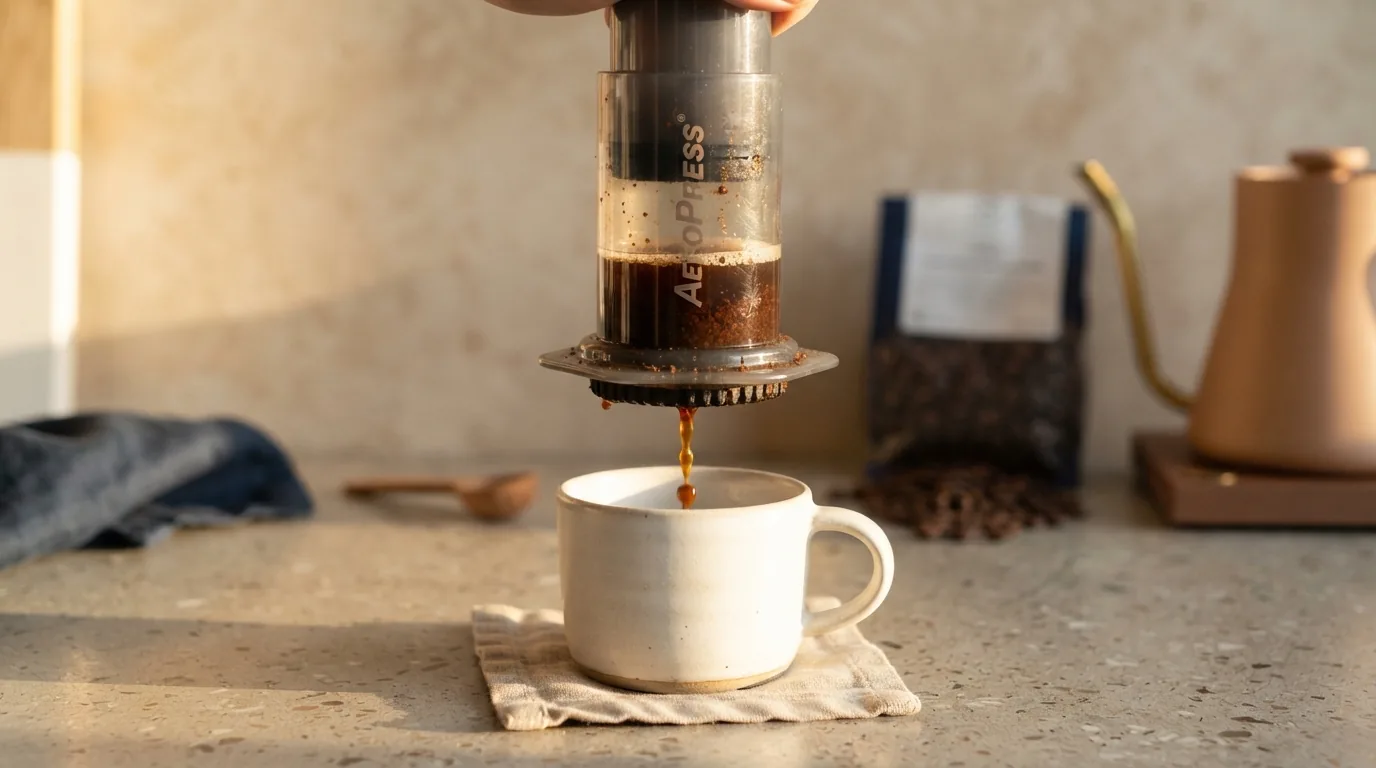
| AeroPress | 1:12 to 1:16 | 15g coffee, 220g water | Wide range by design, dilute after if strong |
| Pour-over | 1:16 to 1:17 | 22g coffee, 360g water | Includes water absorbed by the grounds |
| Drip / batch brew | 1:16 to 1:18 | 55g coffee per liter | The SCA golden cup range |
| French press | 1:15 to 1:17 | 30g coffee, 480g water | Full immersion, slightly stronger |
| Cold brew | 1:8 | 125g coffee, 1L water | A concentrate, diluted roughly 1:1 to serve |
“Extraction is how much you pulled out of the coffee. Ratio is how much water you spread it across. They're different questions, and confusing them is why so many dial-in attempts go nowhere.”
Why Espresso Is Measured Differently
Espresso ratios describe dry coffee against liquid espresso in the cup, not against water entering the machine. A 1:2 ratio means 18 grams of grounds producing 36 grams of espresso. The difference matters because the puck retains a meaningful amount of water, so measuring input water would overstate what you actually drink.
Within espresso, the convention runs from roughly 1:1 for a ristretto through 1:2 for a standard shot to around 1:3 or beyond for a lungo. Our ristretto vs lungo vs espresso guide covers what each of those actually changes in the cup.
Ratio and Extraction Are Not the Same Thing
This is the distinction that unlocks everything else. Extraction yield is the percentage of the coffee's mass that dissolved into the water, and it's controlled mainly by grind size, time and temperature. Ratio is how much water that dissolved coffee is distributed through, and it controls strength.
You can have a properly extracted cup that tastes weak because the ratio was too wide, and an under-extracted cup that tastes strong because the ratio was too tight. Fixing the wrong one is why people end up adding more coffee to a sour brew and making it worse. Our espresso troubleshooting guide covers telling those two failures apart by taste.
Weigh It, Don't Scoop It
Ground coffee's density changes with roast level, grind size and humidity, so a level scoop delivers a different mass from one bag to the next and sometimes from one day to the next. That inconsistency compounds through every other variable in your routine, which is why a technique that worked yesterday can produce a different cup today for no visible reason.
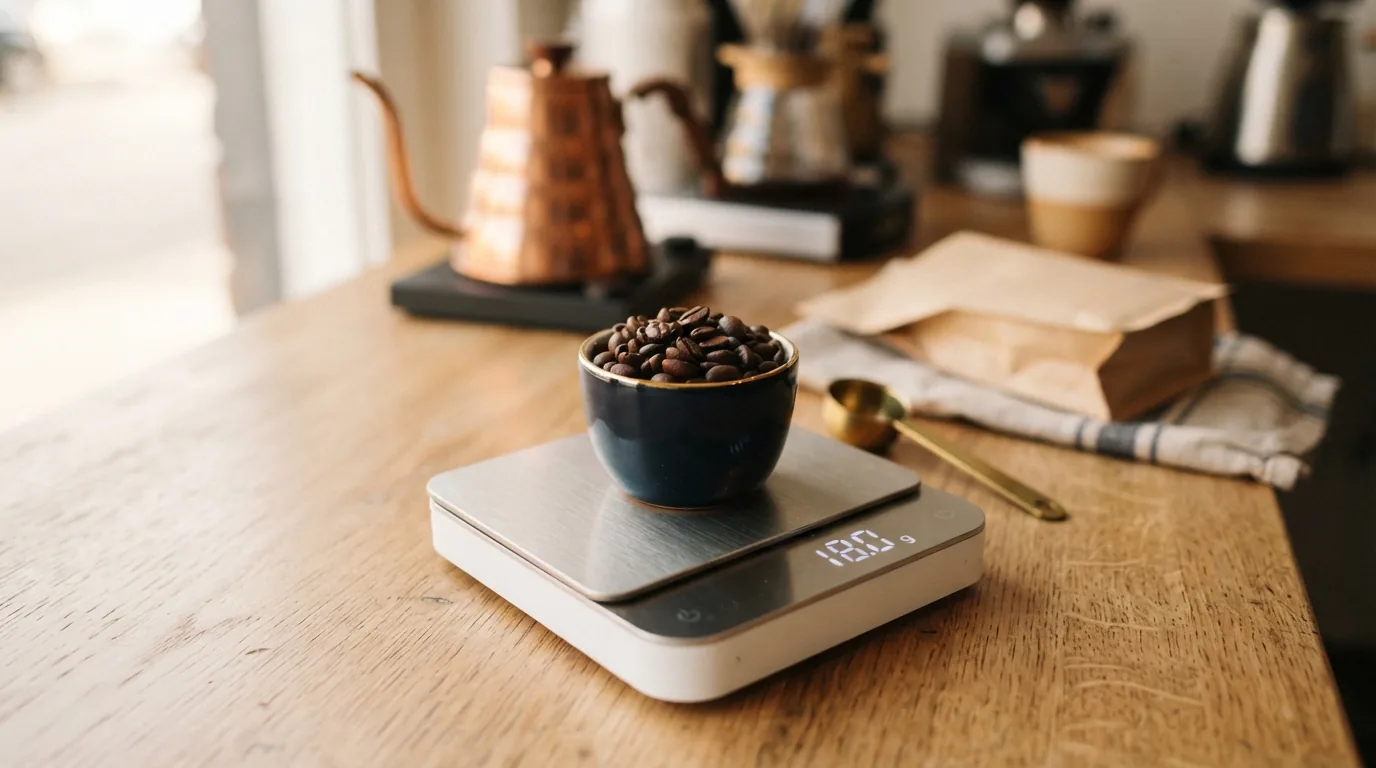
A scale that reads to 0.1g removes it entirely and costs less than almost any other upgrade that changes results this much. For drip and pour-over, 1g precision is sufficient; for espresso, where a gram of dose meaningfully shifts the shot, 0.1g is the practical standard.
Timemore Black Mirror Basic Coffee Scale
0.1g precision with a built-in timer and a compact low-profile design, the accuracy brew ratios actually require, $54.90
Adjusting From a Starting Point
Treat a published ratio as a hypothesis rather than a destination. Start at 1:16 for pour-over or 1:2 for espresso, brew it, and taste. If the cup is balanced but too intense, widen the ratio by adding water rather than changing your grind, because the extraction was already right. If it's thin and sour, that's an extraction problem and the grinder is the correct lever.
Dose scales the whole thing without changing the ratio: 15g and 240g of water is the same 1:16 as 22g and 352g. Adjust dose for how much coffee you want, and adjust ratio for how strong you want it.
Where Water Quality Enters the Equation
Ratios assume the water is doing its job. Coffee is roughly 98 percent water, and mineral content affects how efficiently compounds are pulled from the grounds, which means the same ratio can produce measurably different results on different water. If your brews taste consistently flat despite correct ratios and a fresh grind, water is the variable most people never check. Our water quality guide covers what's actually in your tap water and whether it's worth filtering.